
Femtosecond Laser vs. Microkeratome in LASIK
Understanding Flap Creation Technology
During LASIK surgery, the first step involves creating a thin corneal flap so the excimer laser can reshape the tissue underneath. Two technologies can create this flap: the femtosecond laser (often called bladeless LASIK) and the mechanical microkeratome (a precision oscillating surgical blade). The quality and consistency of this flap play a crucial role in the overall safety and visual outcomes of the procedure. According to a literature review in the Journal of Refractive Surgery covering 95 studies, 92.6 percent of LASIK patients reported being satisfied with their surgery (Susanna et al., 2025).
Understanding how each method works, and how they compare in safety, precision, and recovery, can help you feel confident about the approach that best fits your eyes. At Fairfield County Laser Vision, our refractive surgeon in the greater NY/CT region uses advanced flap creation technology to deliver personalized results for every patient. The choice between femtosecond and microkeratome flap creation is made based on thorough diagnostic testing and careful consideration of each patient's unique corneal characteristics.
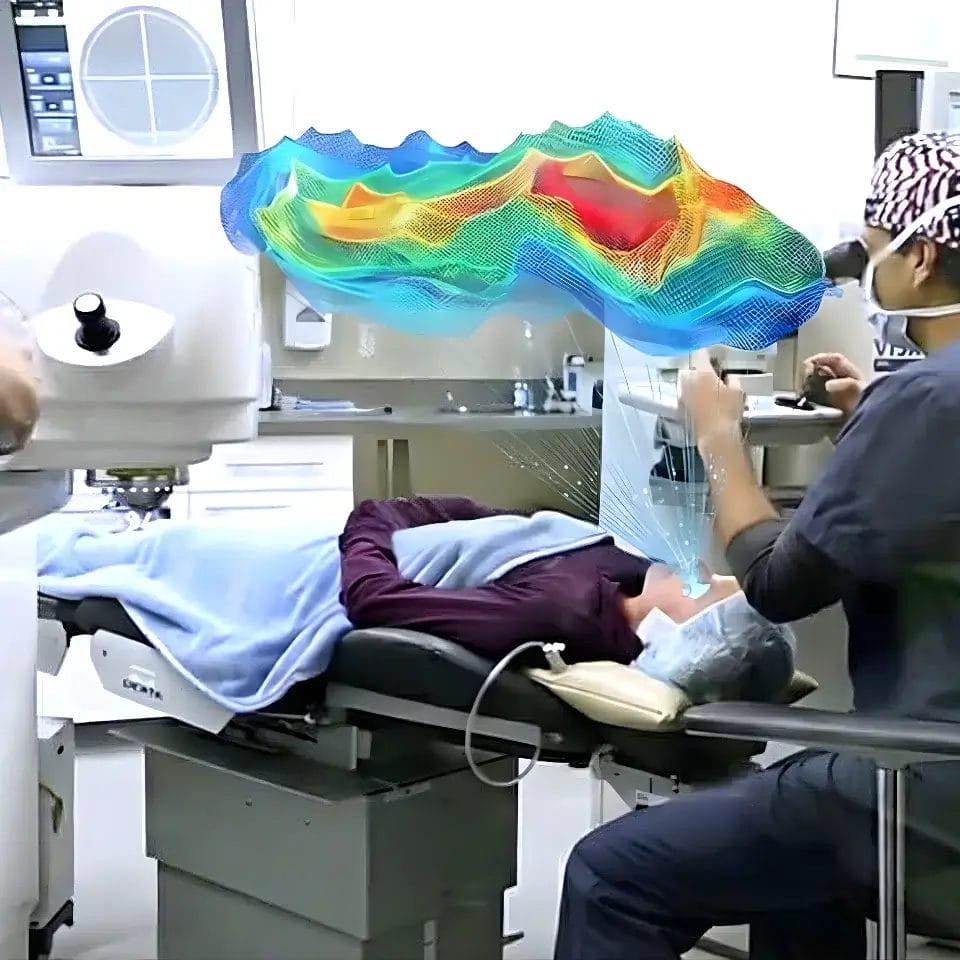
Femtosecond Laser vs. Microkeratome: Key Differences
A femtosecond laser produces ultrafast pulses of infrared light, each lasting one quadrillionth of a second. These rapid pulses create thousands of tiny bubbles at a precise depth within the cornea, forming a smooth plane of separation that the surgeon lifts as a flap. Because the laser is computer-guided, the flap thickness, diameter, hinge position, and edge angle can all be programmed before surgery begins. The femtosecond laser also allows the surgeon to create a beveled edge profile, which can promote more secure flap adhesion during healing.
A microkeratome is a handheld, oscillating surgical blade that passes across the corneal surface under suction to create the flap. It has been used in LASIK since the procedure's earliest years and remains a well-studied, effective tool. Flap dimensions with a microkeratome depend on the blade head selected and the individual characteristics of each cornea. The microkeratome creates a flap with a characteristic meniscus shape, meaning the flap is typically thinner in the center and thicker at the edges.
One of the most consistent advantages reported with femtosecond lasers is greater flap thickness predictability. Studies show that femtosecond-created flaps deviate less from the intended thickness compared to microkeratome flaps, with standard deviations often two to three times smaller. This precision is especially valuable for patients with thinner corneas or higher prescriptions, where preserving as much stromal tissue as possible is important for long-term corneal stability. The ability to customize flap parameters for each individual eye represents a significant advancement in surgical planning.
The femtosecond laser creates a flap with a uniform planar configuration, meaning the flap maintains consistent thickness from the center to the periphery. This contrasts with the meniscus-shaped profile typical of microkeratome flaps. The femtosecond laser also enables creation of a beveled or angled edge, which can enhance flap stability during the healing process. These architectural differences may have implications for both short-term recovery and long-term corneal biomechanics.
Visual Outcomes Comparison
Large-scale clinical studies and a Cochrane systematic review have found no statistically significant difference in final visual acuity between femtosecond laser LASIK and microkeratome LASIK. Both methods routinely help the vast majority of treated patients achieve 20/20 or better uncorrected vision. The excimer laser that reshapes the cornea after the flap is lifted is ultimately the primary driver of visual outcomes. The flap creation step, while crucial for safety and predictability, does not significantly influence the final refractive correction achieved.
Some research suggests that femtosecond LASIK may offer a slight advantage for patients with high myopia. Because the laser can reliably create thinner flaps, more corneal tissue is preserved for the excimer ablation. This additional tissue preservation can make the difference between a patient being a good candidate versus a marginal one. Advanced platforms like WaveLight excimer technology further refine the ablation to optimize visual quality.
Several studies note that patients who receive a femtosecond laser flap may recover functional vision slightly faster in the first 24 to 48 hours. This may be related to the smoother flap interface and more precise tissue separation achieved with the femtosecond laser. However, by one week and certainly by one month, the visual results between both groups are typically equivalent. Most patients are able to return to normal activities within one to two days regardless of the flap creation method used.
Comparing Risks and Complications
Microkeratome flaps are associated with a somewhat higher rate of intraoperative issues such as epithelial defects (surface cell damage), buttonhole flaps, and incomplete or free flap cuts. These complications, while uncommon in experienced hands, can require postponement of the procedure or conversion to a surface ablation technique. Femtosecond lasers significantly reduce these blade-related risks because the flap dimensions are pre-programmed and computer-controlled, eliminating much of the variability inherent to mechanical instrumentation.
Femtosecond LASIK carries a slightly higher incidence of diffuse lamellar keratitis (DLK), a sterile inflammatory response under the flap that typically resolves with anti-inflammatory eye drops. The exact mechanism is not fully understood but may relate to the energy delivered during laser flap creation. Other uncommon complications specific to the femtosecond laser include transient light sensitivity syndrome (TLSS) and opaque bubble layer (OBL), which are generally temporary and resolve without long-term visual consequences.
The total complication rate is comparable between the two methods when performed by experienced surgeons. For patients with borderline corneal thickness or mild surface irregularities, the added precision of the femtosecond laser may offer a meaningful safety advantage. Patients interested in how LASIK compares to surface procedures like PRK can discuss alternatives during a consultation. The choice of flap method should be individualized based on each patient's specific risk factors and corneal characteristics.
Recovery Time and Healing
Most LASIK patients experience functional vision improvement within a few hours of surgery. Patients who receive a femtosecond laser flap may notice slightly less discomfort in the first few hours because the laser applies less mechanical pressure to the eye than a microkeratome. The suction time is also typically shorter with the femtosecond laser, which may contribute to less postoperative inflammation. Both groups typically return to work and most normal activities within one to two days, and most restrictions are lifted within the first week or two.
The beveled or angled edge profile created by a femtosecond laser promotes more secure flap adhesion, which may reduce the risk of flap displacement during early healing. This architectural feature creates a lock-and-key configuration that adds an extra layer of stability. Microkeratome flaps, while also highly stable once healed, have a straight-cut edge that relies primarily on natural suction and epithelial regrowth for adhesion. Both flap types achieve excellent long-term stability in properly screened patients.
Both flap techniques result in corneas that remain structurally sound over the long term when patients are appropriately screened before surgery. The consistent flap thickness achieved with the femtosecond laser helps our refractive surgeon calculate residual stromal bed thickness with greater confidence. Maintaining adequate residual stromal bed thickness is essential for preventing ectasia, a rare but serious complication involving progressive corneal weakening. Patients considering topography-guided surface treatments for irregular corneas may find that the precision of modern laser technology opens additional options.
Frequently Asked Questions
Most LASIK candidates do well with either method. However, patients with thinner corneas, steeper or flatter-than-average corneal curvature, or higher refractive errors may particularly benefit from the femtosecond laser's ability to create reliably thin, uniform flaps. Patients exploring topography-guided LASIK often pair that customized ablation with a femtosecond-created flap for the most precise overall treatment.
No. Each LASIK procedure uses one flap creation method, either the femtosecond laser or the microkeratome. However, both methods are paired with an excimer laser for the vision correction step. The choice of flap method is made before surgery based on the patient's anatomy and prescription, and once the procedure begins, the chosen method is used to completion.
Long-term data spanning five to ten years show excellent visual stability with both methods. A Cochrane review and multiple retrospective studies confirm comparable refractive outcomes at three months, one year, and beyond. Neither technique has demonstrated clear superiority in long-term regression rates. The vast majority of patients maintain excellent uncorrected vision for many years after their procedure.
Key considerations include corneal thickness, the degree of refractive error, individual comfort with blade-based versus bladeless technology, and whether there are corneal irregularities that might benefit from added precision. A thorough preoperative evaluation will reveal which approach is safest for your specific eyes. Your surgeon will review all of these factors with you and explain the reasoning behind their recommendation.
The majority of refractive surgery practices, including ours, have transitioned primarily to femtosecond laser flap creation because of its superior predictability and customization. However, microkeratome LASIK remains a safe, proven technique and may still be appropriate in certain clinical situations. Our refractive surgeon evaluates each patient's corneal topography, thickness, and prescription to recommend the best approach.
Patients considering LASIK after 40 should also discuss whether monovision or other strategies may be appropriate for addressing presbyopia alongside their distance correction. The flap creation method is just one component of the overall treatment plan, and older patients may have additional considerations related to lens changes and reading vision that should be addressed during the consultation.
What our Patients say
 4.8
Reviews
(4001)