Common Causes of Blurry Vision

When Blurry Vision Needs Urgent Care
Some causes of blurry vision are medical emergencies that require same-day or emergency evaluation. Knowing the warning signs can protect your sight and, in some cases, your life.
Vision that blurs or disappears suddenly in one or both eyes can signal a retinal detachment (when the light-sensitive lining at the back of the eye pulls away from its normal position), a stroke, or optic neuritis (inflammation of the optic nerve). A retinal detachment often begins as a shadow or curtain spreading across your field of view. A stroke affecting vision may cause loss on one side of both eyes at the same time.
If you notice your vision turning gray, a dark curtain moving across your sight, or sudden loss of vision in one eye, go to an emergency room or contact your eye doctor immediately. These symptoms should never be waited out.
A sudden burst of new floaters (small dark specks or strands drifting through your vision) combined with flashing lights may mean your retina has torn. This requires same-day evaluation by an eye specialist. Eye pain paired with blurry vision and halos around lights can indicate acute angle-closure glaucoma, a condition in which eye pressure rises to dangerous levels within hours.
Acute angle-closure glaucoma can permanently damage your optic nerve if pressure is not relieved quickly. A specialist can lower the pressure with drops and a laser procedure that restores the eye's natural fluid drainage.
Any blow, scratch, or foreign object that causes blurry vision needs prompt professional evaluation. Corneal abrasions (scratches on the clear front surface of your eye), lens dislocation, and internal bleeding can all worsen quickly without treatment. Even an injury that looks minor from the outside can threaten your vision if the cornea or retina is involved.
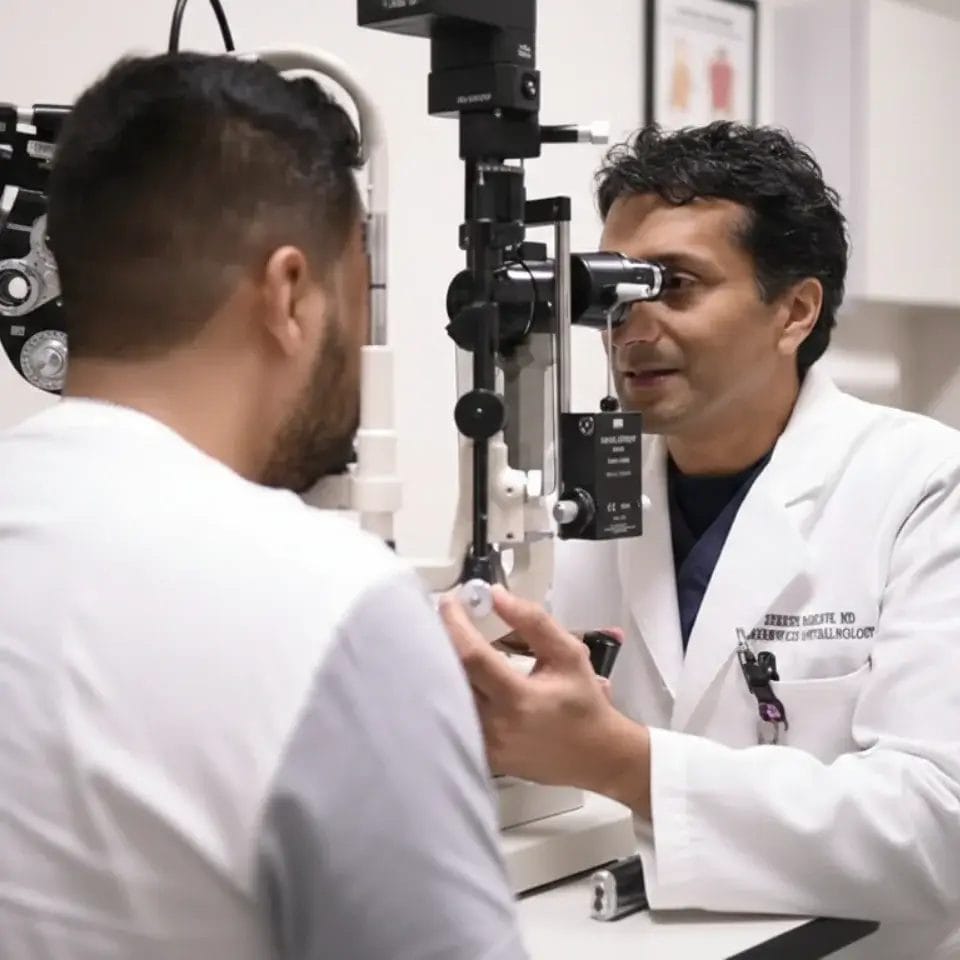
A specialist can examine the eye with a slit lamp (a high-powered microscope with a focused beam of light) to determine whether medication, a protective eye shield, or further care is needed.
Refractive Errors That Blur Your Vision
Refractive errors are the most common reason people experience blurry vision, and they occur when the shape of the eye prevents light from focusing properly on the retina. They are easily diagnosed and reliably corrected with glasses, contact lenses, or refractive surgery.
Myopia (nearsightedness) causes distant objects to appear blurry while objects up close remain clear. The eye is slightly longer than average, so light focuses in front of the retina rather than directly on it. Myopia often develops during childhood and tends to progress through the teenage years.
Our specialists diagnose myopia with a standard refraction test and can prescribe glasses or contact lenses to sharpen distance vision. For qualifying adults, laser vision correction such as LASIK may reduce or eliminate the need for corrective lenses.
Hyperopia (farsightedness) causes blur at close range. The eye is shorter than average, so light focuses behind the retina. In children, the eye can often compensate naturally by flexing the lens, which is why mild hyperopia sometimes goes unnoticed until an exam reveals it.
Adults with uncorrected hyperopia frequently experience headaches or eye strain after reading or close-up work. Glasses, contacts, or refractive surgery can correct the focusing error and ease those symptoms.
Astigmatism causes blurry or shadowed vision at all distances. It occurs when the cornea or lens has an irregular curve that bends light in two directions at once, creating overlapping focal points on the retina. Many people have astigmatism alongside myopia or hyperopia.
Toric contact lenses and glasses with a cylinder correction sharpen vision for people with astigmatism. LASIK can also reshape the cornea to correct the irregular curvature in qualifying patients.
Most adults begin to notice presbyopia around age 40. The eye's natural lens gradually stiffens and loses the flexibility needed to focus on close objects. A common early sign is holding a phone or book at arm's length just to read the text clearly.
Reading glasses, progressive lenses, and multifocal contact lenses all restore near focus. Some patients combine distance contacts with reading glasses to cover the full range of vision comfortably.
Eye Conditions That Cause Gradual Blurring
Several eye diseases cause vision to blur slowly over weeks, months, or years. Because the change can be gradual, many patients do not notice a problem until significant damage has already occurred. Regular comprehensive eye exams are the most reliable way to detect these conditions early.
A cataract is a clouding of the eye's natural lens. Vision may become hazy or dim, colors can appear washed out, and glare from headlights at night often becomes bothersome. Cataracts are the leading cause of reversible vision loss worldwide and the most common reason for vision-restoring surgery in older adults.
Our team monitors cataracts during routine exams. When clouding begins to affect daily activities such as driving, reading, or recognizing faces, a surgeon removes the clouded lens and replaces it with a clear artificial lens implant. Premium multifocal implants can also reduce dependence on glasses after surgery.
Age-related macular degeneration (AMD) affects the macula, the small central area of the retina responsible for sharp, detailed vision. You may notice wavy lines, a blurred or dark spot in the center of your vision, or difficulty reading faces and fine print. AMD is a leading cause of severe vision loss in adults over age 50.
Dry AMD develops gradually as the macula thins over time. Wet AMD progresses faster when abnormal blood vessels leak fluid beneath the retina. Wet AMD is treated with a series of eye injections that block abnormal vessel growth. Monitoring at home with an Amsler grid (a simple checkerboard pattern) helps detect changes between office visits.
In people with diabetes, persistently high blood sugar damages the small blood vessels in the retina. Fluid can leak into the macula and cause swelling called diabetic macular edema, which blurs central vision. Diabetic retinopathy is a leading cause of vision loss among working-age adults.
Annual dilated eye exams are essential for anyone with diabetes, even if vision feels normal. Controlling blood sugar, blood pressure, and cholesterol all slow the progression of vessel damage. When treatment is needed, laser therapy and eye injections can seal leaking vessels and reduce swelling in the macula.
Dry eye disease causes vision that fluctuates between clear and blurry, especially during reading or extended screen use. When the tear film (the thin protective layer covering the front of the eye) breaks down between blinks, it creates an uneven surface that scatters light and distorts vision. Contact lens wearers and frequent screen users face a higher risk.
Artificial tears, warm compresses, and regular screen breaks can ease mild symptoms. When those measures are not enough, a specialist can prescribe anti-inflammatory drops or recommend in-office treatments to support healthier tear production and a more stable tear film.
How Your Eye Doctor Identifies the Cause
Finding the specific cause of blurry vision requires a systematic evaluation. Our specialists use a combination of standard tests and advanced imaging to understand exactly what is happening in your eyes before recommending any treatment.
An eye exam typically begins with a visual acuity test, where you read letters on a chart at a set distance. A refraction test follows, in which you look through a series of lenses to find the combination that gives you the sharpest vision. Together, these two tests identify refractive errors and measure how much correction you need.
If your vision does not sharpen fully with lenses alone, your eye doctor will proceed with additional testing to look for an underlying eye condition.
During a dilated eye exam, drops are placed in your eyes to widen the pupils, giving the doctor a clear view of the retina, optic nerve, and blood vessels at the back of the eye. Dilation typically takes 20 to 30 minutes to take full effect and may blur your near vision for 4 to 6 hours afterward, so plan to have someone drive you home if possible.
A dilated exam is the most reliable way to detect conditions such as diabetic retinopathy, macular degeneration, and retinal tears. Digital retinal images captured during the exam also allow your doctor to track any changes over time.
When a specific condition is suspected, additional diagnostic tools provide more detailed information. Optical coherence tomography (OCT) creates high-resolution cross-section images of the retina to detect swelling, thinning, or fluid buildup. Visual field testing maps your peripheral (side) vision to check for early signs of glaucoma damage.
Corneal topography measures the exact shape of your cornea when irregular astigmatism is suspected. Fluorescein angiography uses a harmless dye to track blood flow through the retina when diabetic retinopathy or wet AMD is a concern. Each test is selected based on your symptoms and exam findings.

Treatment Based on the Cause
Treatment for blurry vision varies widely depending on what is causing it. Our team matches each patient with the approach that best addresses their specific diagnosis and how it is affecting their daily life.
Glasses and contact lenses redirect light so it focuses precisely on the retina. Your prescription is based on your refraction results and should be reviewed regularly as your eyes change. Single-vision lenses correct one focal distance, while progressive or bifocal lenses address both distance and near vision for people with presbyopia.
Toric contact lenses correct astigmatism, and multifocal contact lenses address presbyopia. For patients who prefer to reduce their dependence on lenses, LASIK and other laser vision correction procedures can reshape the cornea for lasting improvement in qualifying individuals.
Cataracts are treated with surgery once they begin to interfere with daily activities. The clouded natural lens is removed and replaced with a clear implant chosen to match your vision goals. Macular degeneration and diabetic retinopathy are often managed with a series of eye injections that reduce fluid leakage and control abnormal blood vessel growth. Laser treatment may also be used to seal damaged vessels.
Your treatment plan depends on your diagnosis, how far the condition has progressed, and how it is affecting your quality of life. Catching problems early through regular exams gives your doctor more options and better outcomes.
Certain daily habits can reduce strain on your eyes and support long-term visual health. For people who spend long hours on screens, the 20-20-20 rule helps: every 20 minutes, shift your gaze to something at least 20 feet away and hold it there for 20 seconds. This allows the focusing muscles in your eyes to relax.
- Wear UV-blocking sunglasses outdoors to protect the retina and lens from sun damage
- Quit smoking, which significantly increases the risk of cataracts and macular degeneration
- If you have diabetes, keep blood sugar levels within your target range to protect retinal blood vessels
- Eat a diet rich in leafy greens and omega-3 fatty acids to support macular health
These habits will not replace the need for regular eye exams, but they do support the health of your eyes between visits.
Frequently Asked Questions
Here are answers to questions we often hear from patients about blurry vision, including when to act quickly and what to expect from an evaluation.
Stress can contribute to eye strain and tension headaches that make vision feel temporarily blurry. This kind of blurring usually clears up once you rest and address the source of stress. However, if blurriness continues after adequate rest, it is worth scheduling an eye exam. Stress alone does not cause the types of blurry vision associated with refractive errors, cataracts, or retinal conditions, so a persistent symptom always deserves a professional evaluation.
A small amount of blurriness right after waking is common and usually clears within a few minutes as the tear film stabilizes across the eye's surface. Sleeping in dry air or with a fan blowing can cause the cornea to dry slightly overnight, leaving temporary unevenness in the tears. If morning blur takes more than 15 to 20 minutes to clear, or if it is happening more frequently, an eye specialist should check for chronic dry eye or a corneal condition.
A difference in refractive error between the two eyes (known as anisometropia) can make one eye blurrier while the other compensates well enough that you barely notice. A cataract developing faster in one eye or a retinal problem affecting one eye can also explain the difference. Any new change where one eye sees noticeably worse than the other should prompt an exam within a few days rather than a wait-and-see approach.
Extended screen use reduces how often you blink, which dries the cornea and causes temporary blur. This often improves with conscious blinking, a few artificial tear drops, or stepping away from the screen for a short break. If screen-related blurring happens daily or gets worse over several weeks, an eye exam is the right next step. Your doctor can assess whether an underlying refractive error or dry eye disease is making the problem worse than it should be.
Blurriness from mild eye strain, fatigue, or temporary dryness often resolves on its own with rest. Blurring from a refractive error will not improve without corrective lenses or surgery. Blurring caused by cataracts, retinal conditions, or glaucoma tends to worsen over time without medical or surgical treatment. As a general rule, any blurry vision that lasts more than a day or two, or that comes on suddenly, deserves a professional evaluation to rule out something that needs care.
A baseline comprehensive eye exam at age 40 is recommended even for adults with no vision symptoms, because many serious eye conditions begin silently and can be detected before they cause noticeable changes. Adults 65 and older benefit from exams every one to two years. Children should have their first eye exam by age 5, or sooner if a parent or teacher notices squinting, sitting very close to the television, or difficulty seeing a board at school.
See Clearly With Expert Care at Greenwich Ophthalmology Associates
Whether your blurry vision turns out to be a simple prescription update or the sign of a condition that needs treatment, getting the right answer starts with a comprehensive exam from a qualified eye specialist. At Greenwich Ophthalmology Associates, our board-certified, fellowship-trained team brings decades of expertise to patients throughout the greater Stamford, CT region, combining advanced diagnostic technology with personalized, compassionate care. We offer both routine and specialty eye care under one roof, so you can get the attention you need in one convenient location. Schedule your appointment online today and take the first step toward clearer vision.
What our Patients say
 4.8
Reviews
(3926)